¶ Hello! It's young Dedalus! What's up? ¶ The sky is up…

Showing posts with label Docklands. Show all posts

26 June 2017

Samuel Beckett Bridge


The Samuel Beckett Bridge is the penultimate bridge when walking towards the mouth of the Liffey.
It is worth the walk, for the striking design is more impressive up-close.


I noticed that the lighting inserted in the footpath seemed to have sea life designs under the glass cover. I had a closer look and spotted some fish and starfish. I made a point of NOT photographing them all, then I read that this was an installation called ‘Freeflow’ made of 900 “small internally lit glass cobbles,” many containing bronze and silver fish. Nine hundred?! I am glad I noticed too late!
This art work is therefore 1 km long and was installed in 2006. 


The artist is called Rachel Joynt, an Irish sculptor, she has also made the metal footprints located on the ground at the southern end of O’Connell Bridge – I used one of my photo as the background for this blog (see the post: http://picturesofdubhlinn.blogspot.co.uk/2017/07/oconnell-bridge.html)


Scherzer rolling lift bridges >
http://picturesofdubhlinn.blogspot.co.uk/2017/06/docklands.html


“Words are all we have…”
Speak for yourself, Sam.
Yes Beckett was a true original, but I never felt any emotional involvement with his work… I am still waiting for… 😈

 The Samuel Beckett Bridge is a cable-stay bridge, here the river is wider and the bridge is 120 metres long.
Opened in 2009, it was designed by the Spaniard Santiago Calatrava, who had designed the 2003 James Joyce Bridge further up the river (http://picturesofdubhlinn.blogspot.co.uk/2017/07/james-joyce-bridge-four-courts.html)

The Samuel Beckett Bridge is a “single-sided forward curved back-stayed pylon, evoking a harp.” There are 31 cables.
Calatrava has in fact pioneered this style, called a cantilever spar cable-stayed bridge – the spar is the pylon. It swings through 90° horizontally, to let boats pass.


‘The Remarkable Rocket’
was written by Oscar Wilde…
No Oscar Wilde Bridge yet…
^ A panoramic view of the whole length of the Samuel Beckett Bridge, facing the estuary of the Liffey.
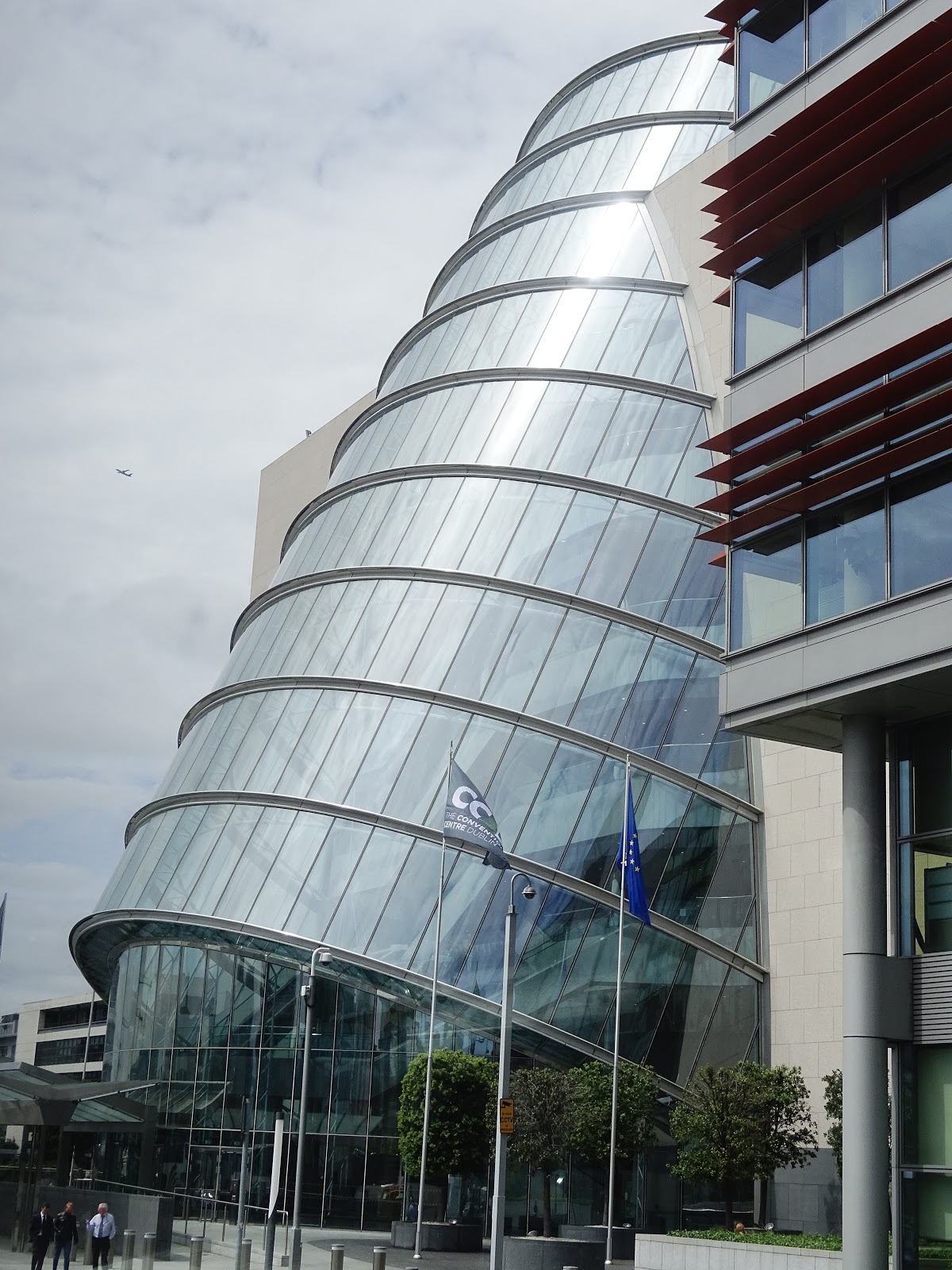
The Convention Centre Dublin on the north bank
The Diving Bell on the south bank

^ Liberty Hall, Custom House and The Spire


This bridge is a road and pedestrian bridge. It is rather wide with 2 double lanes of traffic, while the pedestrians share a separate set of lanes with cyclists, on either side.
As things stand in Dublin, the traffic is horrendous and it is nearly impossible to take a photo without a dozen cars or a throng of fast moving people in it. 
But I tried. 


25 June 2017

Seán O'Casey Bridge


The Seán O’Casey Bridge is in the Docklands, near the Famine Memorial and the Jeanie Johnston Ship.
It is named after the Dublin-born playwright and I was looking forward to see the bridge up close, because I enjoyed his writing: his plays and more specially his autobiography. An incredible account of personal hardship and of the political confusion that was taking place in Dublin during the time of the 1916 Easter Rising and the Irish Civil War that followed. The roots of patriotism and people’s motives not always as clear cut as we would imagine, there is no idealism in the books except for the betrayed ideals, and yet, always that Irish resilience running through. He was an autodidact and that makes his style of writing even more impressive.
Well, can I say I was disappointed? I shouldn’t compare the bridges and I know that Beckett is an international figure in literature… but why did he get the big harp whenever he wrote in French?
Although, I may have been quick to judge: I must say that when looking at it from the side, it looks like there are two giant seagulls gliding over the surface of the water; the cable is not held by vertical pylons, but by some grey curved frames – and they are hardly any bigger than the actual herring gulls encountered in Dublin! 
The Seán O’Casey Bridge is a 100-metre long pedestrian swing bridge that opened in 2005. Irish designer: Cyril O’Neill of Brian O’Halloran and Associates. The two sections of the bridge, sitting on granite piers, can swing through 90° and rest parallel with the river to let boats pass. Indeed, it seems to span quite low.
With the cable on the sides stretching over the water, it reminded me a little of the London Millennium Footbridge. Except this is a very understated structure. It doesn’t help that it is a bit dirty, with some uncalled-for graffiti, like the whole of Dublin city centre in fact…


The swing bridge does vibrate a lot and one bounces if there are only even a couple of other people walking on it. This makes it quite a noisy place and there is nothing but metal - it does not make one feels like hanging around.


Is that a  Sheela Na Gig figure? 
What is it doing here? 
“Dublin is a city full of ghosts… Dublin is a city full of humour… 
Dublin is a city full of wonder, Dublin is a city full of shite”  Mike Scott 
(quotes from his 1995 song ‘City Full of Ghosts’)

Dublin is a city full of parked bicycles, gulls, cars, cranes, road works, noise and graffiti…

Next post: the Samuel Beckett Bridge

Docklands

The Convention Centre Dublin and Scherzer bridges, North Dock

The Butt Bridge (1932) with Jeanie Johnston Tall Ship and the Samuel Beckett Bridge along the river. Skyscrapers are George’s Quay (2002) and nicknamed Canary Dwarf.

There are two pairs of Scherzer rolling lift bridges on the north bank of the river. This one is at Custom House Quay and could allow for the road to be raised for access to George’s Dock which is just off the river, but now dry.
^ George’s Dock
The other pair of Scherzer rolling lift bridges is at North Wall Quay and goes over the Royal Canal, where the canal meets the River Liffey.
Those Scherzer bridges are bascule bridges with counterweight. They date from 1911-12 and were designed in Illinois, USA.


The CCD, Convention Centre Dublin (2010) at Spencer Dock, a conference and event venue >
Here, where the Royal Canal (1790) meets the Liffey, there is water and some young people in wetsuits were getting ready to jump in (top pic in this post).


The CCD was built in Modern style and the half-circular rims are lit up at night >


Central Bank of Ireland,
North Wall Quay,
North Dock >
^ The CCD seen from the southern end of the Samuel Beckett Bridge, 
with the Diving Bell on the right of the pic
(see previous post http://picturesofdubhlinn.blogspot.co.uk/2017/06/poverty-stone-jeanie-johnston-ship.html).
Next two posts:
the Seán O’Casey Bridge and
the Samuel Beckett Bridge